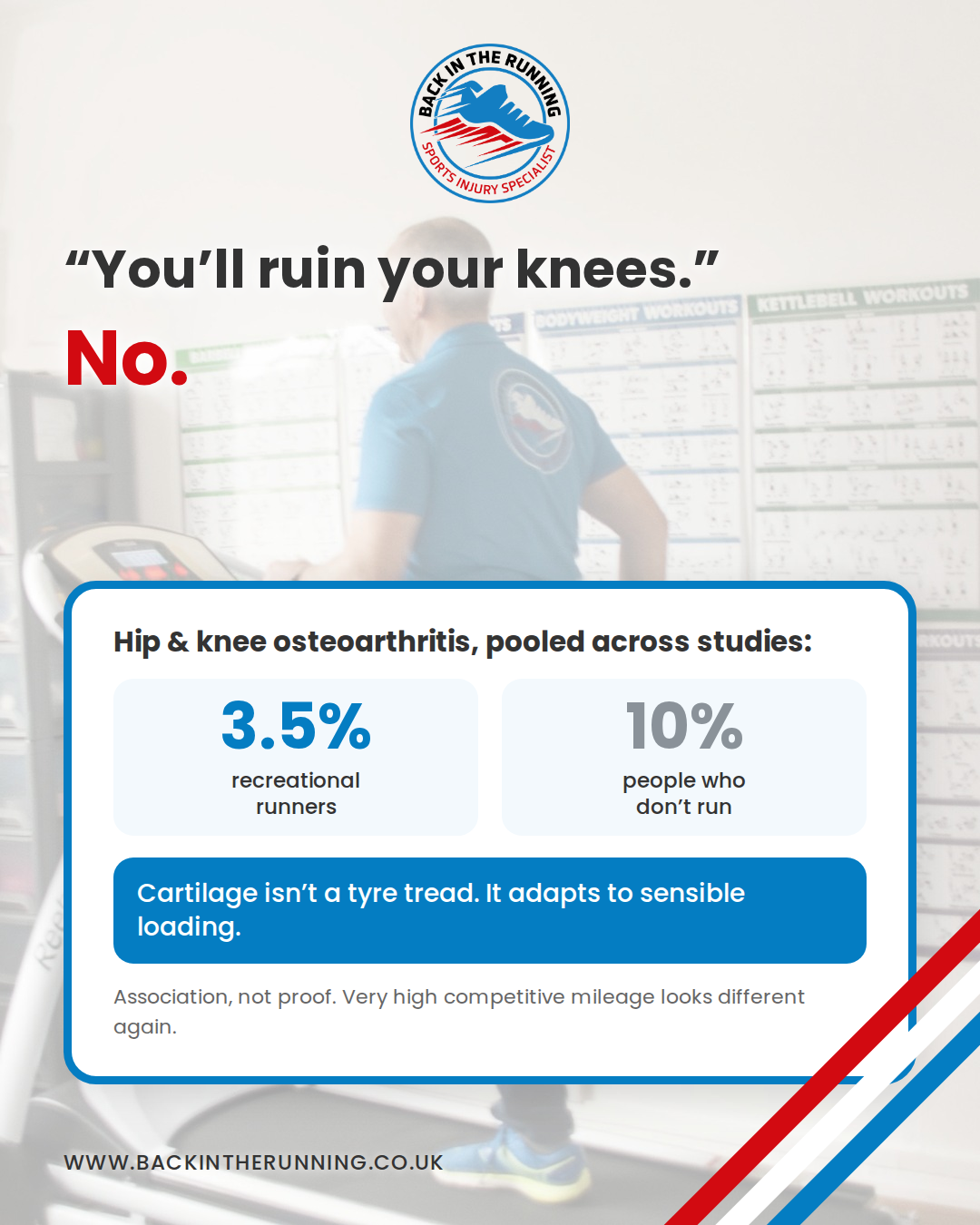
Short answer: no. Recreational runners have less hip and knee arthritis than people who don’t run at all.
Most runners have been told this one — often by people with no reason to doubt it, because it has been repeated confidently for decades.
It is worth taking seriously, because of all the things runners get told, this is the one that changes behaviour most. I have sat with people who had already started planning the version of their life where they didn’t run any more, on the strength of a single sentence someone said to them years ago.
What the numbers actually show
In 2017 a group of researchers pulled together twenty-five studies covering more than 125,000 people and pooled the results. They compared how often hip and knee osteoarthritis showed up in runners against people who did not run.
Prevalence of hip and knee osteoarthritis
- 3.5% in recreational runners
- 10.2% in controls — people who did not run
- 13.3% in competitive runners — professional and elite athletes, and international competitors
Running for less than fifteen years was associated with a lower rate of hip and knee arthritis than not running at all.
So the club runner doing four or five sessions a week is not in the risk group. If anything, they are in the group doing better than the person on the sofa.
The honest caveats
I am not going to oversell this, because overselling it is exactly what the other side does.
This is an association, not proof. The authors say so themselves — they could not determine whether the relationship was causative or explained by other factors, previous injury among them. Runners are also a self-selecting group: people whose knees already hurt tend to stop running, which drags the numbers in a helpful direction on its own.
And notice the competitive figure. Very high volume and intensity sustained over many years does sit higher than everyone else. That nuance usually gets left out by both camps, and it shouldn’t be.
What none of it supports is the sentence your colleague said in the kitchen.
Cartilage isn’t a tyre tread
Underneath the fear is usually a mental picture: a fixed amount of cushioning in your knee that wears thinner with every mile, and once it is gone, it is gone.
That is not how the tissue behaves. Cartilage is living tissue with cells in it, and like the rest of you it responds to load. Loaded sensibly, with enough recovery between sessions, it adapts — the same principle that makes your legs stronger rather than gradually using them up.
The thing that genuinely does not agree with joints is doing nothing at all.
What if your knee actually hurts?
Then it is worth looking at — but as a problem to solve, not as a preview of your sixties.
Knees are the single most commonly injured area in runners, and for most people that traces back to load rather than anything structural. Take 24 to 48 hours off and see how it settles. Most things do. If it hasn’t settled, or it keeps coming back to the same spot every time you build your mileage, get it assessed properly.
One more thing, and I think it matters more than the statistics. The fear itself changes what people do. Less running, then more deconditioning, then more sensitivity, then more pain — and the belief ends up producing the thing it predicted. If you take one thing from this, let it be that you are allowed to keep running.
Source: Alentorn-Geli E, et al. The Association of Recreational and Competitive Running With Hip and Knee Osteoarthritis: A Systematic Review and Meta-analysis. J Orthop Sports Phys Ther. 2017;47(6):373-390. doi:10.2519/jospt.2017.7137
Knee pain that keeps coming back? I run online injury assessments for runners — no travel, no waiting list, and you’ll come away with a plan built around your actual training week.
Run happy and injury free.
Leave a Reply