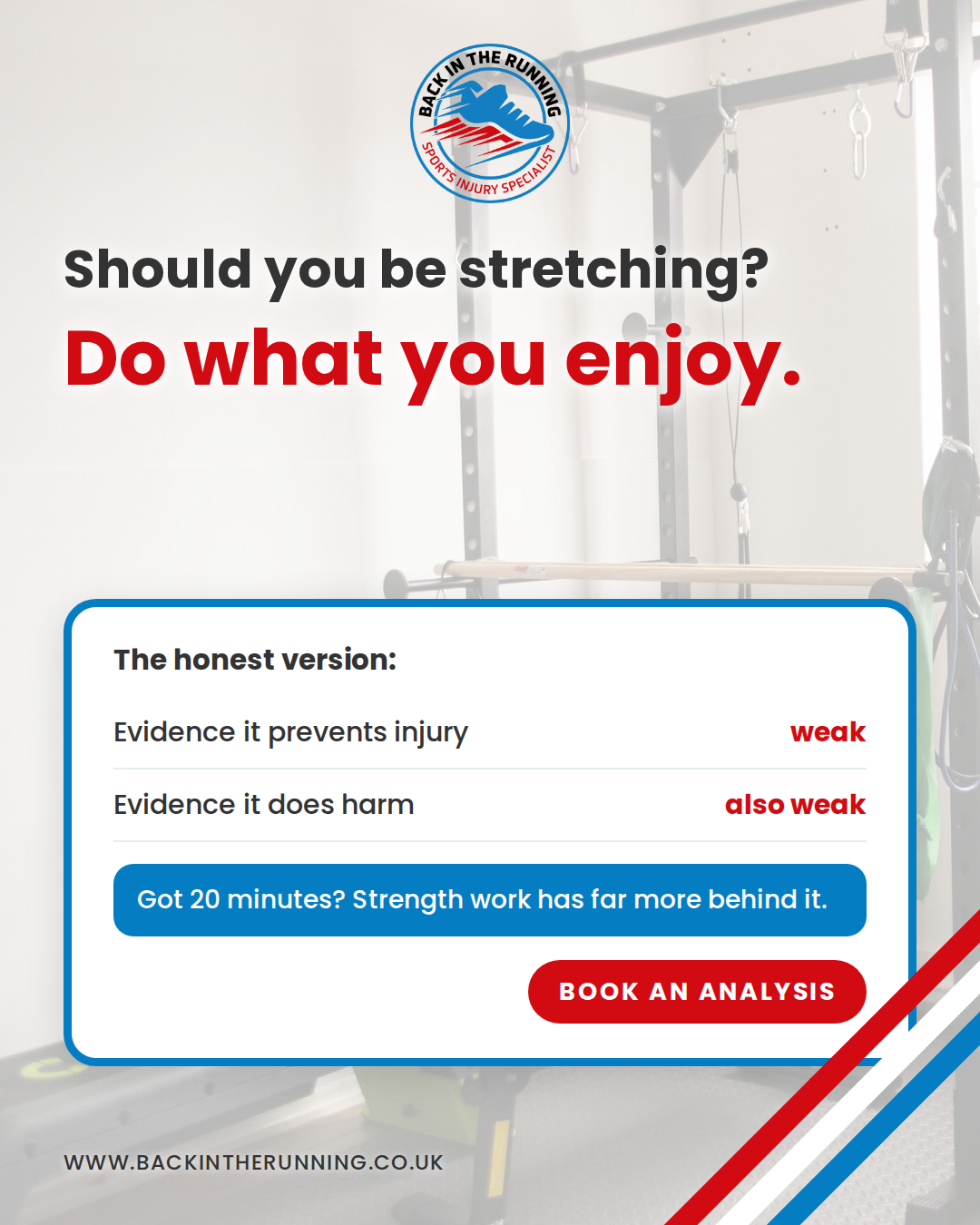
Short answer: do what you enjoy. It is not a satisfying answer, but it is the honest one.
This is one of the few questions that reliably starts an argument at a running club. Every few months someone asks me to settle it, and every few months I disappoint them.
Part of the problem is that both camps are overclaiming. One generation was told stretching was essential and non-negotiable. The next was told it was useless and possibly harmful. Runners got the whiplash, and a fair few of them concluded that nobody knows anything — which is understandable, and not quite right either.
What the evidence shows
The injury-prevention case for static stretching is weak. Systematic reviews looking at static stretching as part of a warm-up have not found a meaningful reduction in injury rates. That finding has been fairly stable for two decades now.
So if you are stretching primarily because you believe it stops you getting injured, that belief is not well supported.
And what it doesn’t show
Here is the part the anti-stretching camp tends to skip: the evidence against it is thin too.
Nobody has demonstrated that stretching does harm. The performance concerns that got so much attention involve holds considerably longer than anyone does in practice, and they mostly matter if you are about to sprint or jump rather than head out for an easy five miles.
So we are left with genuine uncertainty, and I think saying that plainly is worth more than picking a side. If you enjoy stretching, if it is part of how you wind down after a run, if it makes you feel ready to go — carry on. You are not making a mistake.
The question I’d ask instead
The interesting question is not whether stretching is good or bad. It is what else you would do with that time.
The twenty-minute question
If you have twenty minutes twice a week and you are choosing between stretching and loaded strength work, the strength work has substantially more behind it. A carefully set up plan can support your running and reduce your risk of injury — and that is a stronger claim than anything I can make about stretching.
It does not need to be complicated. Calf raises, single-leg work, something for the hips and glutes, progressively loaded over time. Twice a week is enough for most runners.
What I’d actually do before a run
Warm up by running. Start the first ten minutes genuinely easy — slower than feels dignified — and let things loosen as you go. If you are heading into something faster, add a few strides and some easy drills once you are warm.
Afterwards, do whatever you like. If that includes stretching because it feels good, that is a perfectly reasonable use of ten minutes, and “it feels good” does not need evidence to justify it.
If something is already sore
Stretching into a painful area, particularly a grumbling tendon, often makes it more irritable rather than less. If you find yourself stretching the same spot repeatedly for relief that never lasts, that is not a flexibility problem — it is a signal to get it looked at.
Take 24 to 48 hours off first and see how it settles. If it hasn’t, that is the point to get some help rather than stretching it harder.
Want strength work that fits round your actual training week? I run online injury assessments for runners — no travel, no waiting list, and you’ll come away with a plan built around the running you are already doing.
Run happy and injury free.
Leave a Reply